Quantum RF Skin Tightening
Removing fat is not enough — the skin must retract
Liposuction reduces volume. But a second factor determines the result: how well the skin adapts to that reduced volume.
This varies from patient to patient — skin quality, age, history of pregnancy and weight change, and the region itself all matter. Even when the fat removal is technically flawless, an unretracted skin envelope leaves the contour short of what was intended.
Quantum RF addresses that second stage. It is performed in the same session, once the fat removal is complete.
Two techniques, one operation
Vaser uses ultrasound energy to selectively emulsify fat. Because it dissolves fat rather than breaking it up mechanically, it causes less trauma to vessels, nerves and connective tissue.
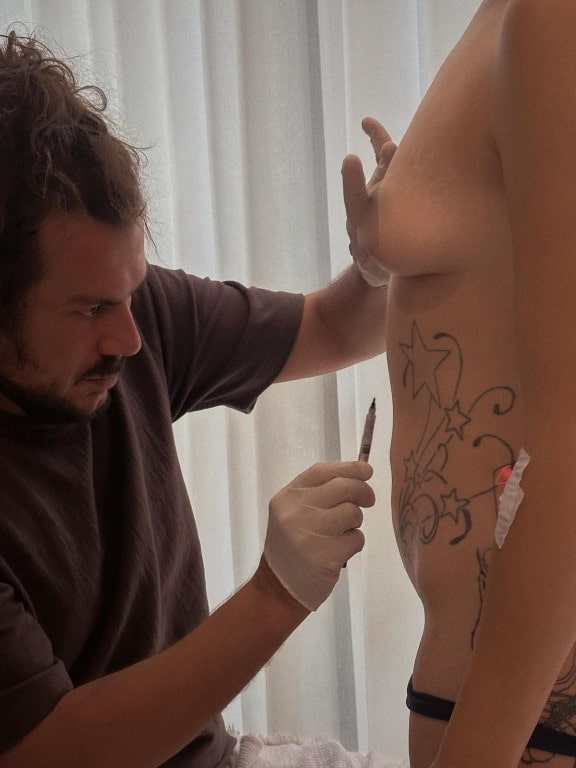
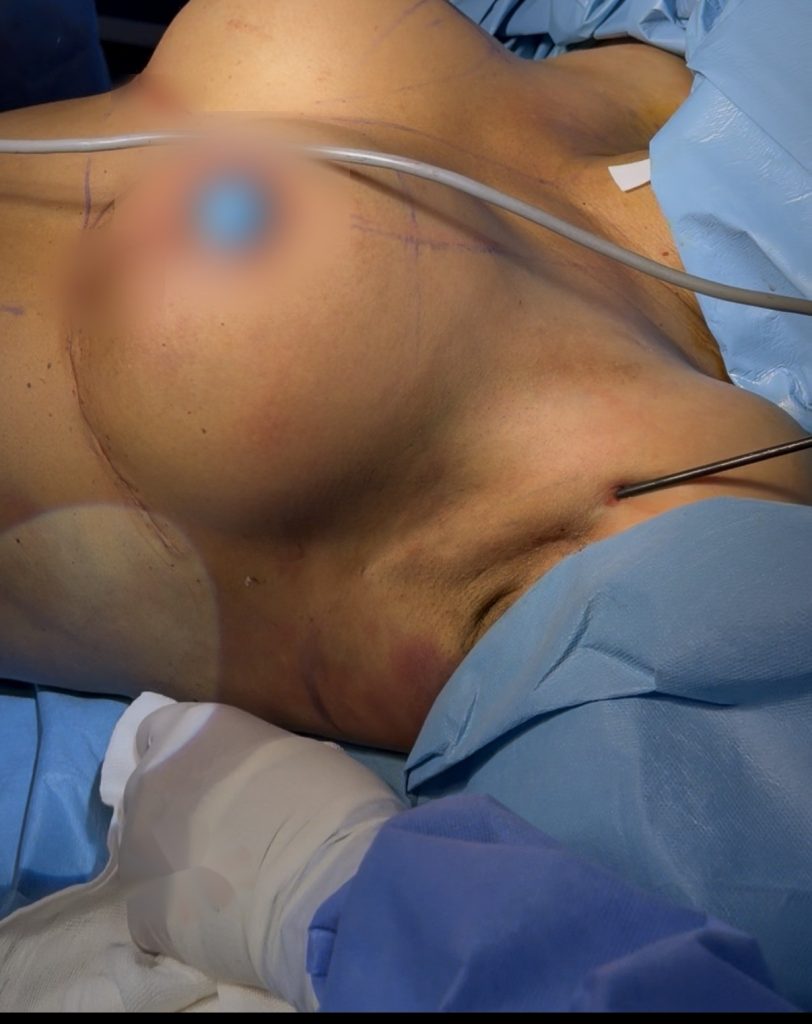
Quantum RF then delivers controlled radiofrequency energy beneath the skin. A slim, Teflon-coated probe is placed subdermally; the energy heats the connective tissue network that supports the skin, producing contraction and subsequently stimulating collagen formation.
Two probe lengths are used: the longer probe for broad areas such as the abdomen, back and thighs; the shorter probe for narrow, thin-skinned regions such as the neck, submental area and inner arm. Entry points are chosen in concealed sites such as the axilla.
Less bleeding, and in most patients no drain
As the radiofrequency energy heats tissue it also coagulates small vessels, which reduces bleeding during the procedure.
This has a tangible consequence for the patient: in patients treated with Quantum RF we usually do not use a drain.
A drain is a thin tube placed to evacuate fluid after surgery. It restricts movement, complicates dressing, and requires a separate visit for removal — one of the details patients complain about most during recovery. Avoiding it improves comfort considerably.
This is not the case for every patient. If the procedure is extensive or combined with another operation, a drain may still be required. That decision is made during surgery.
An operating theatre is not always necessary
Large-volume liposuction — abdomen, back, thighs — requires general anaesthesia and operating theatre conditions.
Small areas are different. In limited regions such as the axilla or the area above the knee, where skin laxity is mild, the procedure can be performed under local anaesthesia in the office.
For the patient this matters: no general anaesthesia, no operating theatre, no hospital stay. Normal activity resumes the same day.
Which category you fall into depends on the size of the area and the degree of skin laxity. This is determined at consultation.
When results appear
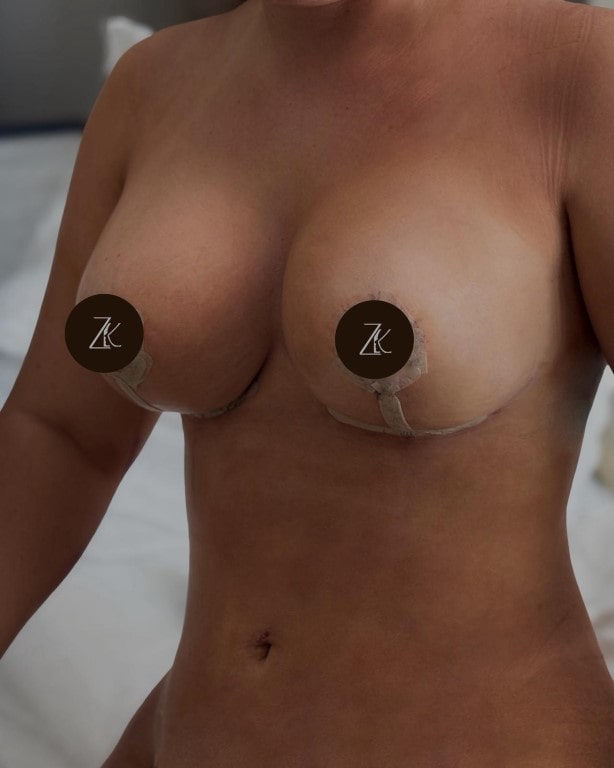
The effect develops in two stages. Part of it is visible during the procedure; the main result emerges gradually over weeks, because collagen formation takes time.
Assessment is therefore not made at a single point: the result is reviewed at three and six months. What is seen before the swelling resolves and collagen settles is not the final outcome.
Who is suitable
- Patients with excess fat accompanied by mild to moderate skin laxity
- Areas where skin elasticity has decreased after weight loss but sagging does not warrant excisional surgery
- Regions where the skin is thin and retracts poorly: neck, submental area, inner arm, inner thigh
- High-definition liposculpture plans where muscular definition is to be preserved
Who is not suitable
In advanced skin laxity, radiofrequency alone is not sufficient. Such patients obtain a more reliable result from excisional procedures — abdominoplasty, arm lift or thigh lift.
Pushing radiofrequency will not make lax skin tight; it will only leave the patient short of their expectation. We make that distinction at consultation.
It is also not performed in patients with uncontrolled systemic disease, bleeding disorders, or who are pregnant or breastfeeding.
Recovery
Extensive procedures are performed under general anaesthesia or sedation, with discharge the same day or after one night. Small-area treatments under local anaesthesia require no stay.
Swelling, bruising and tenderness are expected in the first days. Compression garment use is part of recovery; its duration depends on the region. Return to desk work is possible within a few days for most patients; sport and heavy activity await a follow-up examination.
Most of the swelling resolves within the first weeks, but the final shape takes months to settle.
Risks
Every energy-based procedure carries risk.
Common effects are temporary: swelling, bruising, skin tenderness, numbness and a firm sensation. Less commonly, thermal skin injury, contour irregularity, seroma or persistent sensory change may occur.
The device continuously monitors tissue temperature and cuts the energy when the limit is exceeded. Nevertheless, correct depth, correct speed and correct patient selection remain the surgeon’s responsibility, independent of the device.
Current evidence
Radiofrequency-assisted lipolysis has been in clinical use for years, with published data on skin retraction.
The Quantum probe is the newest member of that family. Its effect on skin laxity in patients undergoing high-definition liposculpture is still being investigated in an ongoing clinical study with follow-up to six months.
Suitability is assessed individually, taking both the available evidence and clinical experience into account.
Frequently Asked Questions
Is Quantum RF a separate operation?
No. It is performed in the same session, after the fat removal is complete. There is no additional operation and no additional recovery period.
How does it differ from Vaser?
They do different things. Vaser dissolves and removes fat. Quantum RF supports skin retraction afterwards. One concerns volume, the other the surface.
Is general anaesthesia always required?
No. For large areas, yes — but small regions such as the axilla or above the knee can be treated under local anaesthesia in the office.
Will I have a drain?
Because Quantum RF reduces bleeding, we usually do not use a drain in these patients. It may still be needed depending on the extent of the procedure.
Will there be scars?
The probe is introduced through the millimetric access points already made for liposuction. No separate incision is made.
When will I see the result?
Part of it appears early; the main change develops over weeks. It is assessed at three and six months.
Will weight gain affect the result?
The removed fat cells do not return, but the remaining cells can enlarge with weight gain. Maintaining a stable weight is necessary for durability.
Travelling from abroad?
Patients come to Istanbul for this surgery from all around the world. Your plan covers everything around the operation: a private hospital on Istanbul’s Asian side, five-star accommodation with breakfast and one companion included, private transfers from either Istanbul airport, a private nurse around the clock, lymphatic drainage massage, garments and medication, and regular video follow-up after you fly home — all included, not added on.
From your first message to your last follow-up, you speak directly with Dr. Zafer Kaya. A 10% deposit secures your date; the balance is settled only after you have met your surgeon in Istanbul.